Warehouse shelving looks like a commodity purchase. It is not. Two quotes for what appears to be the same 5-tier boltless unit can differ by 40%, and the gap is rarely profit margin — it is steel thickness, decking material, coating quality, and how the load rating was actually calculated.
This guide is written for buyers who purchase by the container: importers, distributors and warehouse managers specifying a new racking run or restocking a range. It walks through the decisions that move capacity and cost, in the order you should make them.
1. Start with what you are storing, not with the shelf
Most bad shelving decisions start with a catalogue page. They should start with your stock. Three questions settle more of the specification than anything else:
- What is the heaviest single item? Not the average carton — the outlier. A shelf rated for 500 kg uniformly distributed can still fail under a 200 kg point load concentrated on one corner.
- Is the weight uniform or concentrated? Cartons and tote bins spread load. Machine parts, dies, tyres and coils do not.
- How do people pick from it? Front-edge picking suits shallow shelves. Deep storage suits large, slow-moving stock.
Those answers map onto the three standard duty classes. Use this as a first filter:
| What you are storing | Typical duty | Load per shelf |
|---|---|---|
| Small parts, retail backroom stock, archive boxes | Light duty | 100–150 kg |
| Case picking, spare parts, workshop consumables | Medium duty | 200–300 kg |
| Machine parts, tooling, tyres, drums, bulk stock | Heavy duty | 500 kg and above |
2. Work out the load you need per shelf
A real load requirement has three numbers, not one: the load on a single shelf, the total load in one bay, and the load each upright has to carry. Suppliers who quote only the first number are telling you a third of the story.
Load ratings are normally stated as a uniformly distributed load (UDL) — weight spread evenly across the whole shelf panel. The moment you put a pallet of steel fittings on one end, you are outside that assumption. If your stock is dense, ask for a point load figure as well. There is a full explanation in Shelf Load Ratings Explained.
Once you have the number, buy above it. A useful working margin is 25–30% headroom on the rated figure, which absorbs impact damage from forklifts and pallet trucks and gives you room for stock that gets heavier over time.
3. Size the bay around your cartons, not the other way round
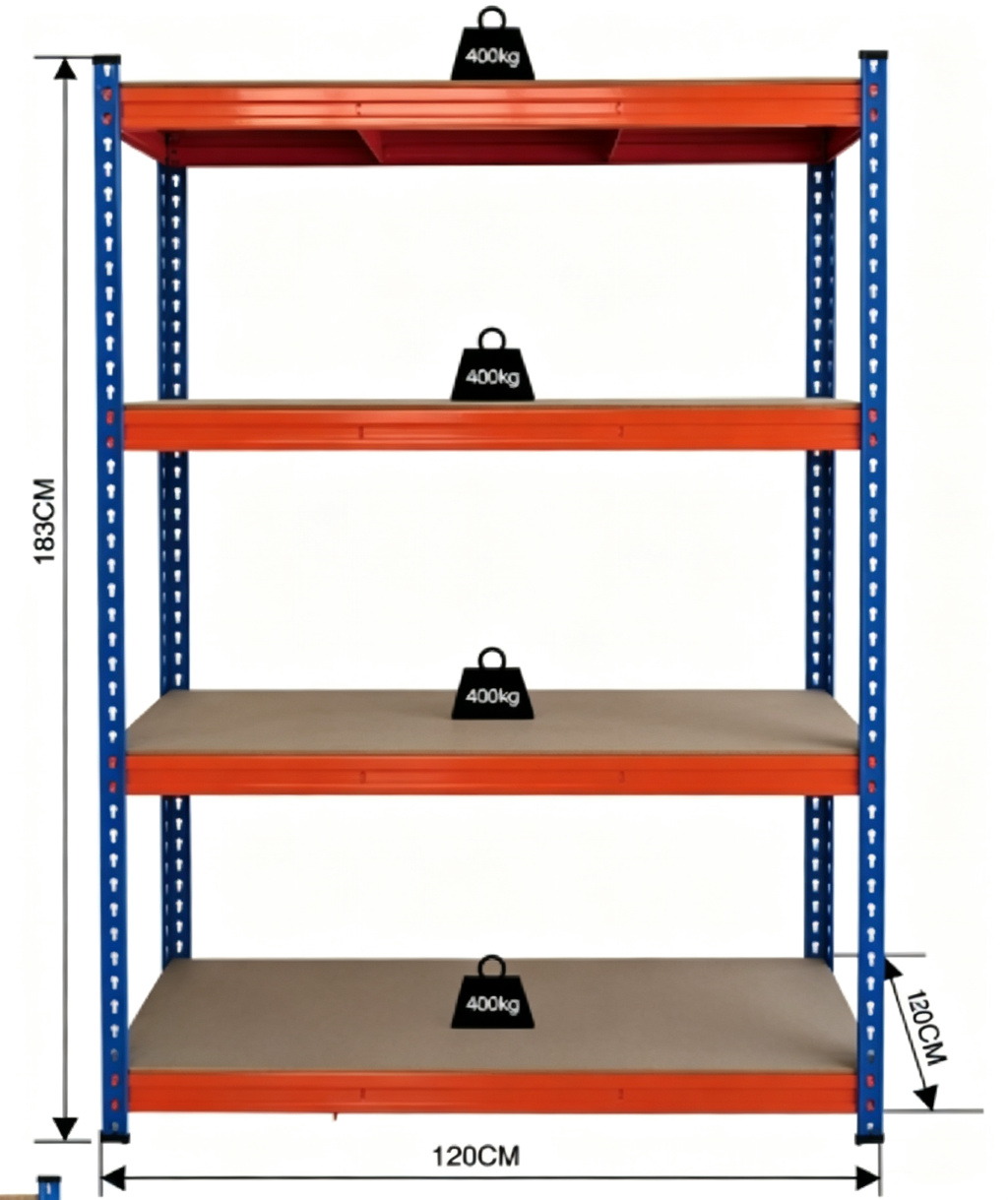
Standard steel shelving comes in a small number of bay widths because that is what loads efficiently into a container. The common set is 1,200 mm, 1,600 mm and 2,000 mm (47 in, 63 in, 79 in), with a shelf depth of 600 mm (24 in) and heights of 1,830 mm or 2,000 mm (72 in / 79 in).
Those are starting points, not limits — custom widths and depths are usually available on a container-volume order. What matters is picking the size that fills efficiently:
- Measure your carton footprint and find the width that gives you a whole number of cartons per shelf. Wasted width is wasted steel.
- Height should be clear opening, not shelf pitch. A 4-level unit with 400 mm clear openings stores more than a 5-level unit with 300 mm openings if your cartons are 350 mm tall.
- Depth beyond about 600 mm makes rear stock hard to reach and encourages things to disappear at the back.
4. Decide boltless or bolted
This is the structural choice, and it affects assembly labour far more than it affects price. Boltless systems assemble with a mallet and no fasteners; bolted systems use nuts and bolts on an angle profile and are slower to build but stiffer in high-traffic or high-vibration settings.
We cover the trade-off in detail in Boltless vs Bolt-Together Shelving. As a rule of thumb: if it is installed once and loaded by hand, boltless is almost always the better buy. If it is loaded by machine or it moves, look harder at bolted.
5. Choose the deck material
| Deck | Best for | Watch out for |
|---|---|---|
| MDF or particle board | General storage, flat and quiet surfaces, lowest cost | Swelling in damp or unheated buildings; not washable |
| Steel panel | Heavy point loads, cold stores, food and pharmaceutical areas | Higher cost; can dent under impact |
| Wire mesh | Airflow, dust-free storage, sprinkler coverage | Small items fall through; needs a shelf liner |
Decking is one of the easiest places for a supplier to cut cost invisibly. Ask for the board thickness in millimetres, and for steel decks, the gauge. “Board shelf” on a spec sheet tells you nothing.
6. Match the finish to the environment
Electrostatic powder coating over Q235 structural steel is the default for good reason: it is durable, touch-up-able and available in any RAL colour. But the environment decides more than the colour card.
- Dry warehouse or workshop: standard powder coat, blue, orange, black or grey.
- Damp, unheated or cold store: galvanised uprights, or a higher coating thickness. Standard powder coat will chip and rust at the base plates.
- Colour-coded zones: any RAL colour, which is cheaper than painting aisles and makes picking errors visible.
Ask for the coating thickness in microns. A typical industrial powder coat is 60–80 µm; if a supplier cannot tell you the figure, they are not measuring it.
7. Plan the container before you place the order
If you are importing, freight is not an afterthought — it is a design constraint. Knocked-down flat packing is standard for good reason: unassembled uprights and shelf panels nest efficiently and let you move far more units per container than shipping assembled.
Tell your supplier the container type and the target quantity early. A 40 ft high cube loads very differently from a 20 ft, and the difference between a quote that fills the box and one that leaves 15% air is pure margin. If a supplier quotes you a price without asking about the container, they are guessing.
8. Check the floor and the aisles
Two physical limits get missed constantly. First, floor loading: a bay carrying 5 shelves at 500 kg each transmits 2,500 kg plus the frame through four base plates. On a mezzanine or an older slab, that needs checking before delivery, not after.
Second, aisle width. A rule of thumb set:
- 900 mm (35 in) — single person picking on foot
- 1,800–2,200 mm (71–87 in) — hand pallet truck
- 2,700–3,000 mm (106–118 in) — reach truck turning
Add headroom for sprinkler clearance and lighting if the run goes above 2 m.
9. Compare cost per shelf position, not price per unit
Price per bay is the number buyers look at and the one that misleads most. The number that matters is cost per usable shelf position:
Cost per position = price per bay ÷ number of shelf positions per bay
A 5-level bay at $120 holds five positions at $24 each. A 4-level bay at $104 holds four positions at $26 each, but if the 5-level bay has openings too short for your cartons, it delivers fewer usable positions than the 4-level bay — and you paid more per usable space. Spec the opening height from your stock before you compare prices.
10. What to check before you commit to a supplier
Documentation is where a serious supplier separates from a reseller. On a container order, expect to receive:
- Material and load documentation — mill certificates, dimension sheets, coating thickness readings and load test reports on request.
- Pre-shipment evidence — inspection records and container loading photographs sent to you before the container leaves, not after it arrives.
- A claims route with a clock on it — a written proposal within 48 hours of photos or an inspection report reaching the supplier.
- A warranty with defined edges — tiered 1, 2 or 3 years from the bill of lading date depending on range, covering manufacturing defects, and excluding overload, misuse and site damage.
- A sample route — a small, refundable deposit that is credited against your first order.
- Third-party inspection — you should be free to appoint an inspector. Expect to pay for it; insist on the right to do it.
Quick selector
| If you need… | Look at |
|---|---|
| Fast, tool-free assembly at the lowest cost per position | Rivet shelving |
| Repeated reconfiguration as your stock mix changes | T-hole shelving with keyhole uprights |
| Maximum stiffness for machine loading | Grooved shelving with bolted connectors |
| Long spans and cut-to-length frames | Slotted angle shelving |
| A closed, tidy look for retail or office stockrooms | Full steel shelving |
| Light backroom and archive storage | Light duty shelving |
| Tyres and awkward round stock | Tyre rack |
| Heavy mixed stock, 500 kg per shelf | Heavy duty shelving |
Frequently asked questions
How much weight can warehouse shelving hold?
Light duty shelving typically carries 100–150 kg per shelf, medium duty 200–300 kg, and heavy duty from 500 kg upward. Those figures assume a uniformly distributed load. Concentrated loads, damaged uprights and incorrect assembly all reduce real capacity, which is why a margin above your calculated requirement is worth paying for.
Do I need bolts to assemble steel shelving?
Not for boltless systems, which use slotted or keyhole uprights and drop-in shelf panels. Assembly needs a rubber mallet and no tools. Bolted systems use fasteners throughout and are slower to build but stiffer under machine loading and repeated movement.
Can I mix shelving sizes in one container?
Yes, and most importers do. Mixed widths, heights and colours load together without difficulty because everything ships knocked down. Mixing sizes within a container order usually improves loading efficiency rather than hurting it.
How long does a shelving order take?
Lead time depends on whether the sizes and colours you want are in stock or need production. Standard sizes in stock colours move fastest; custom RAL colours and non-standard dimensions add production time. Ask for a dated lead time in writing against your specific specification, not a generic figure.
Tell us what you are storing
Send us the load per shelf, the bay size you have in mind and your target quantity. You will get pricing, lead time and one or two questions worth settling before you commit. Mixed sizes, trial orders and OEM/ODM are all welcome.
Keep reading: Boltless vs Bolt-Together Shelving · Shelf Load Ratings Explained · Importing Steel Shelving from China