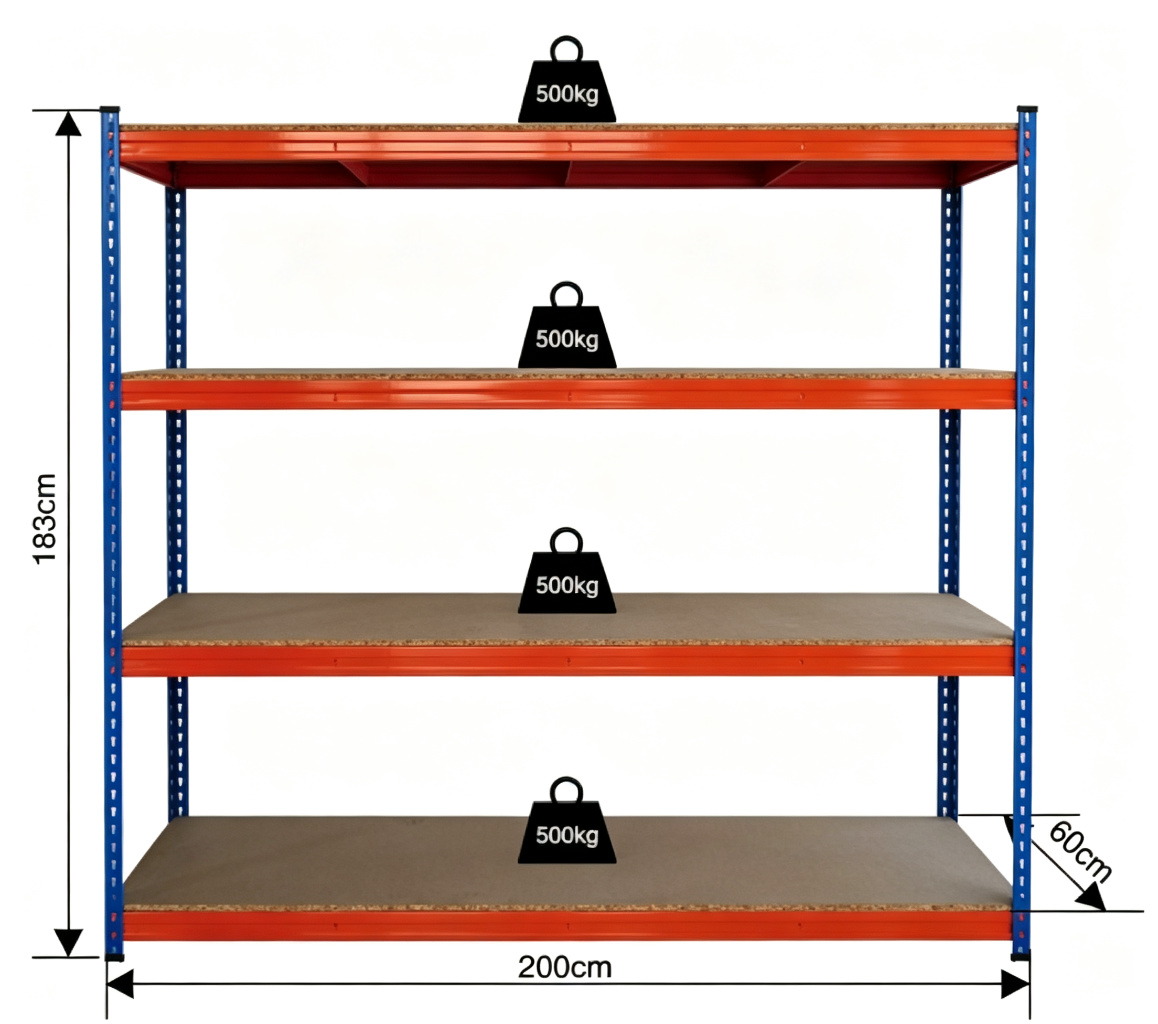
“500 kg per shelf.” It is the number buyers compare, and it is the number most often misunderstood. A shelf genuinely rated at 500 kg can be overloaded, damaged or unsafe at 200 kg if the weight arrives in the wrong place — and it can carry 650 kg safely in the right conditions.
Load ratings are not a single figure. They are a set of assumptions, and this article explains what they are so you can specify and compare shelving without guessing.
The three numbers behind every rating
When a supplier says “500 kg per shelf”, three separate limits are hiding in that sentence:
- Load per shelf — how much weight one shelf panel can carry before it deflects beyond its limit or yields.
- Load per bay — the total across all levels in one bay. This is what the uprights and base plates actually have to hold.
- Load per upright — the compressive load in a single post, which sets the steel thickness and the frame design.
A spec sheet that only gives you the first number is incomplete. Ask for all three, or ask for the bay capacity and derive it.
UDL versus point load
Almost every published shelf rating is a uniformly distributed load, or UDL. That means the stated weight spread evenly from end to end of the shelf, front to back. Steel resists that shape of load very well.
A point load is the opposite: the same weight concentrated in one spot. A 250 kg engine block on a shelf rated 500 kg UDL is not a comfortable 50% of capacity. It is a localised stress that can permanently bend the panel if it sits between supports or near an unsupported edge.
The practical rules that follow from this:
- Put dense, heavy items over or near an upright, not in the middle of a span.
- Use a steel deck rather than board for genuine point loads.
- If the load is concentrated, ask for the point load rating rather than the UDL figure — and expect it to be lower.
- Spread loads across the shelf rather than stacking them in one corner.
Deflection: the limit you never see
Steel bends under load. The rating is not the weight at which steel breaks — it is usually the weight at which the shelf deflects to a defined fraction of its span, most often L/180. A 1,200 mm shelf is allowed to sag about 6.7 mm at its rating.
That deflection limit exists for a reason:
- Items roll and slide toward the low point, which is a genuine safety issue on heavy stock.
- A permanently sagged shelf does not spring back once overloaded past yield.
- Repeated flexing fatigues the panel and can work the connection loose.
This is why two shelves with identical steel thickness can carry different ratings: a shorter span deflects less, so it earns a higher number. Span, not just material, sets capacity.
| Bay width | Practical effect on rating |
|---|---|
| 900–1,000 mm | Shortest span, highest capacity for the same steel |
| 1,200 mm (47 in) | The common middle ground for heavy duty shelving |
| 1,600 mm (63 in) | Wider opening; needs thicker deck or more support for the same load |
| 2,000 mm (79 in) | Long span; usually a beam-and-deck system rather than a single panel |
How the rating is arrived at
Ratings come from either a physical load test or a structural calculation. Both are legitimate, and both depend on the assumptions behind them. A test on a single assembled bay on a flat floor tells you about that bay — not about a 20-bay run where the frames are bolted together and the floor is not level.
Two questions worth asking a supplier:
- Is this rating tested or calculated, and to which standard?
- Does the rating assume the bay is free-standing, or tied into a run?
A supplier with real data will answer both on the spot.
Static versus dynamic loading
All standard shelf ratings assume static storage — weight placed and left. If the shelf takes impact from a forklift, a pallet truck, or stock thrown onto it, the effective load spikes well above the static weight for a fraction of a second, and steel does not forgive that.
Where dynamic loading is routine, the response is not a bigger number on the spec sheet. It is a different design: bolted connections rather than clips, a heavier upright, and impact protection at the base of the frame. See Boltless vs Bolt-Together Shelving for how the connection choice changes behaviour under load.
Environmental derating
Ratings are published for a dry, ambient indoor environment. Real warehouses are not always that:
- Cold stores — steel is not dramatically weaker at −20 °C, but board decks fail and standard coatings chip. Specify galvanised uprights and steel decks.
- Wet or humid areas — corrosion thins the material silently. A pitted upright is a de-rated upright.
- Chemical or coastal air — salt and aggressive atmospheres attack coating and base metal. Higher coating thickness or galvanising is not optional.
Damp and sub-zero sites are the most common reason a correctly rated rack fails early in service.
Worked example: what five shelves actually load
This is where the per-shelf figure stops being the whole story. Take a standard heavy duty bay:
| Item | Value |
|---|---|
| Shelves per bay | 5 |
| Rated load per shelf | 500 kg |
| Total stock load in the bay | 2,500 kg |
| Frame self-weight (typical) | 40–60 kg |
| Load carried by each of 4 uprights | roughly 640 kg |
| Load through each base plate to the floor | roughly 640 kg on a footprint of a few square centimetres |
Two conclusions follow. First, the uprights and base plates are carrying far more than any single shelf figure suggests, which is why steel thickness on the post matters more than almost anything else in the specification. Second, that concentrated floor pressure is why a mezzanine, a first-floor slab or an older concrete floor needs checking before a tall, fully loaded run goes in.
The right working method is to add up your real stock weight per shelf, add a 25–30% margin for impact and future growth, and then pick the duty class that covers it. How to Choose Warehouse Shelving walks through that calculation in order.
The numbers to ask for before you order
- Load per shelf, and whether it is UDL or point load
- Total load per bay and per upright
- Upright steel thickness in millimetres
- Deck material and thickness
- Deflection limit used for the rating
- Coating thickness in microns, or galvanised / not
- Whether the rating is tested or calculated, and to which standard
- Base plate dimensions and floor pressure
If a supplier answers all eight, the shelf will do what the sheet says. If they answer two, you are buying on hope.
Frequently asked questions
Does 500 kg per shelf mean 500 kg anywhere on the shelf?
No. It means 500 kg spread evenly across the panel. The same weight concentrated in one spot can deflect or damage the shelf, because local stress is far higher than the uniform case. For concentrated items, use a steel deck and ask for a point load rating.
Can I exceed the rated load occasionally?
Ratings already include a margin, but it exists to cover variation and minor impact, not routine overload. Steel that deflects past its yield point does not return to shape. Once a shelf is visibly bent, the rating no longer applies and the panel should be replaced.
Do more shelves per bay mean a lower rating each?
Not to the shelf itself — the per-shelf rating holds. But each additional loaded level adds to the load carried by the uprights and the floor. A 5-level bay puts roughly 25% more load down each post than a 4-level bay of the same rating, which is what limits how tall and how heavily loaded a run can safely go.
How do I know if a rating is realistic?
Ask for the upright thickness, the deflection limit and whether the figure was tested or calculated. Low thickness plus a high rating plus no documentation is a warning sign. Thick steel, a sensible deflection assumption and a load report on request is what a genuine rating looks like.
Get a load figure you can rely on
Send us the weight per shelf, the bay size and the environment. We will come back with a quoted load rating, the upright gauge behind it, and the documentation to support it — mill certificates, dimension sheets, coating thickness readings and load reports on request.
Keep reading: How to Choose Warehouse Shelving · Boltless vs Bolt-Together Shelving · Importing Steel Shelving from China