Ask two suppliers to quote for “heavy duty shelving” and you may get two structurally different products: one that assembles with a mallet in ten minutes, and one that arrives with bags of nuts and bolts and takes an hour. Both are called boltless or bolted shelving, and the choice affects assembly labour, stiffness and how easily the rack can be changed later.
This article compares the two systems honestly, including the cases where bolted still wins.
What “boltless” actually means
Boltless shelving is not a single product. The name describes the connection method, and there are three common variants in industrial shelving:
- Rivet or clip shelving — uprights have perforations that take steel rivets or clips. Shelf panels drop in and the clip locks them. This is the fastest system to assemble. See rivet shelving.
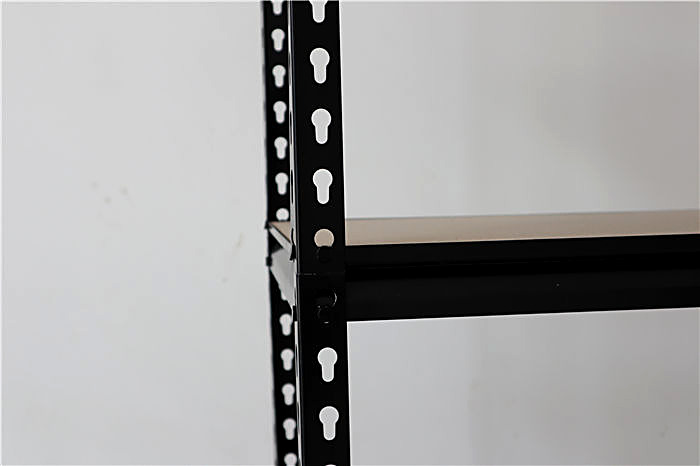
- Keyhole and T-hole uprights — the upright is punched with a keyhole or T-shaped slot, and shelf beams or brackets hook in and drop to lock. Tool-free, very quick, and designed for repeated reconfiguration. See T-hole shelving.
- Grooved posts with drop-in connectors — a grooved profile takes interlocking connectors instead of bolts. Fewer parts than bolted, more rigidity than a simple clip system. See grooved shelving.
What “bolt-together” actually means
Bolted shelving uses fasteners at every joint. The classic form is slotted angle — a perforated L-profile cut to length and bolted into frames — which remains popular because it is infinitely adjustable and easy to extend with basic tools. See slotted angle shelving.
The trade-off is labour. Every joint is a bolt, a nut and a spanner. On a single bay that is ten minutes. On a 500-bay warehouse fit-out it is days of installation labour, and that cost lands on you, not the supplier.
Head to head
| Boltless (rivet / keyhole) | Bolt-together (slotted angle) | |
|---|---|---|
| Assembly per bay | 5–15 minutes, no tools | 30–60 minutes, spanner required |
| Skill required | Low — one person, a mallet | Moderate — two people on tall frames |
| Load per shelf | Up to 500 kg and beyond | Comparable, if the profile is thick enough |
| Stiffness under machine loading | Good with a locking clip or beam | Very good — every joint is pre-tensioned |
| Reconfiguration | Fast, non-destructive, reuse the same parts | Slower; bolt holes fatigue if reused repeatedly |
| Level adjustment | Set pitches, sometimes half-pitch on keyhole posts | Continuous along the slot |
| Parts count | Low — fewer things to lose on site | High — fasteners per joint, per bay |
| Vibration resistance | Adequate for static storage | Better — correct choice where vibration is constant |
| Installed cost | Lower once labour is counted | Higher unit price plus higher labour |
The assembly time question, in real numbers
Suppliers quote assembly times that assume an experienced fitter and a clean floor. Apply a reality factor. Bolted shelving that a supplier calls “30 minutes” typically runs 45–60 minutes for a two-person crew who have not built that system before.
Now scale it. A 200-bay installation at 15 minutes of saving per bay is 50 hours — more than a working week of labour recovered, before you count the downtime of the space you are fitting out. That is the real argument for boltless, and it is not about the hardware price at all.
Do boltless systems carry less weight?
This is the most common misconception. A well-made boltless system carries the same load as a bolted one, because the load path runs through the upright, not through the joint. A keyhole post that hooks a beam into a punched slot and drops it to lock is structurally sound and, in many warehouse racks, is the standard connection.
What reduces capacity is thin steel, not the absence of bolts. A 1.2 mm upright will fail where a 2.0 mm upright holds, whatever the connection method. Ask for the steel thickness of the upright in millimetres and compare that number, not the assembly style.
Stiffness, sway and why it matters
Bolted connections are, in effect, pre-loaded. Each tightened bolt clamps the joint, which resists the small movements that accumulate into sway in a tall, free-standing run.
That does not make boltless unstable — it means tall boltless runs need the same bracing discipline as any rack:
- Anchor or foot-plate the uprights on any run above about 2 m.
- Fit diagonal or horizontal bracing at the ends of a run, and repeat it every few bays.
- Bolt runs together back-to-back or into a wall where the layout allows.
- Never remove a brace to gain access and leave it off.
Reconfiguration: the hidden advantage
Warehouse stock mixes change faster than racking does. A boltless keyhole system lets you move a shelf level, change a bay height or split a run without new parts and without damaging anything. Reusing the same components across two or three layout changes is normal.
Bolted systems can be reconfigured too, but every rebuild means removing fasteners from holes that have already been loaded. Do it enough times and the holes oval, joints loosen and the frame should be inspected before it is reloaded.
Cost: unit price versus installed cost
Bolted slotted angle is often cheaper per kilogram at the steel yard, which is why it still wins on small, one-off jobs where the buyer is also the installer.
Once you start paying for installation, the arithmetic flips. Always compare two numbers, not one:
- Landed hardware cost — unit price plus freight plus duty per shelf position.
- Installed cost — hardware plus labour hours per bay at your own labour rate.
When boltless wins
- Hand-loaded storage of cartons, totes, spares and parts
- Large installations where assembly labour is the dominant cost
- Stock mixes that change and layouts that get revised
- Any site where the people building it are not fitters
- Cold stores and food areas, where fewer joints means fewer places for moisture and debris to collect
When bolted wins
- Constant vibration, such as next to compressors, presses or heavy conveyors
- Machine-loaded positions where impact is routine and joints must stay tight
- Frames that must be cut to unusual dimensions on site, where slotted angle is unbeatable
- Small jobs where the same person buys and builds, and unit price is the whole story
- Frames carrying point loads in unusual locations, where a bespoke bolted bracket is the cleanest solution
The pragmatic answer: mix them
Most large warehouses do. Boltless rivet or keyhole shelving carries the bulk of hand-picked stock, while bolted slotted angle or grooved shelving frames handle the positions that take machine loading, vibration or non-standard dimensions.
If you are buying by the container, the practical split is usually 70–80% boltless and the remainder bolted for the awkward positions. That gets you the assembly saving on the volume and the stiffness where it is actually needed.
Frequently asked questions
Is boltless shelving as strong as bolted shelving?
Yes, when both are built from equivalent steel. Load travels down the upright, not through the joint. Capacity is set by the thickness of the upright and the deck, the bay span and the bracing — not by whether the joint uses a clip or a bolt.
Can boltless shelving be taken apart and rebuilt?
Repeatedly, which is one of its main advantages. Boltless joints are designed to release without damage. Bolted joints can be rebuilt too, but holes and threads wear each time, so inspect the frame before reloading after several rebuilds.
Which is better for a cold store?
Boltless, generally, because there are fewer fasteners to corrode and fewer joints to clean. Whichever system you choose, specify galvanised uprights or a heavier powder coat for damp and sub-zero environments, and avoid MDF decks, which absorb moisture.
Do I need tools to assemble boltless shelving?
A rubber mallet is usually the only tool, and sometimes not even that. No spanners, no bolt kit, and nothing to lose on site. That is a large part of why boltless systems dominate hand-loaded warehouse storage.
Which one fits your operation?
Tell us what you store, how it is loaded and how often your layout changes. We will tell you which system we would put in, and which we would not. Pricing, lead time and the two or three questions worth settling come back with it.
Keep reading: How to Choose Warehouse Shelving · Shelf Load Ratings Explained · Importing Steel Shelving from China