Sourcing steel shelving from China is straightforward when the specification is tight and the paperwork is agreed in advance — and expensive when it is not. Most problems that reach a warehouse do not come from bad steel. They come from a vague specification, an undocumented load claim, and a claims process nobody discussed until there was a claim.
This checklist is written for importers, distributors and private-label buyers placing container orders. Work through it before you ask for a price, and you will get quotes that can actually be compared.
1. Start from the container, not the catalogue
Freight is a design constraint, not an afterthought. Knocked-down flat packing is standard for steel shelving because uprights and panels nest efficiently and let you move far more units per box than assembled goods.
Before you request pricing, know:
- The container type you intend to use (20 ft or 40 ft high cube)
- The target unit mix — widths, heights, levels and colours
- Whether you want a full container of one size, or a mixed load
A supplier who quotes without asking about the container is guessing at your landed cost. Mixed sizes usually load better than a single size, not worse.
2. Build the landed cost before you build the price list
Ex-works unit price is the least useful number in the negotiation. Compare landed cost per shelf position:
- Unit price per bay
- Inland haulage and port charges at origin
- Ocean freight and insurance
- Import duty and any additional trade measures
- Port fees, customs clearance and delivery to your warehouse
Then divide by usable shelf positions, not by bays. A cheaper bay with an opening height your cartons do not fit gives you fewer positions and a worse cost per position.
3. Know your duty position by market
Duty treatment for steel shelving is market-specific and it changes. Two things worth checking before you price a programme:
- Europe — the EU opened an anti-dumping investigation into Chinese steel shelving in 2026, covering CN codes ex 9403 20 80 and ex 9403 99 10. If you resell into the EU, get a customs opinion before you commit to a price. Measures of this type are EU-specific; shipments into other regions are not affected by that particular case.
- North America — additional tariffs on Chinese steel products may apply on top of standard duty. Confirm current rates with your customs broker rather than taking a number from a supplier.
The supplier should be able to tell you the HS or CN code and the correct product description. The duty opinion itself is your customs adviser’s job.
4. Specify steel, not adjectives
“Heavy duty” and “high quality” are marketing words. They are not comparable between suppliers and they are not enforceable. Replace them with numbers:
| Vague | Specify this instead |
|---|---|
| “Strong steel” | Upright steel thickness in mm, and grade (e.g. Q235 structural steel) |
| “Good finish” | Electrostatic powder coat, thickness in microns, RAL colour reference |
| “Strong shelf” | Load per shelf, UDL or point load, plus deck material and thickness |
| “Standard size” | Bay width, shelf depth and height in mm, with inch equivalents |
| “Well packed” | Carton dimensions, units per carton, pallet plan and container load quantity |
If two suppliers cannot give you the same set of numbers, you are not comparing the same product — and the gap between their prices is probably the thickness of the steel.
5. Ask for the documents that de-risk the order
On a container order, the paperwork is as much a part of the product as the racking. Before you place an order, ask what you will receive and when:
- Mill certificates for the steel
- Dimension sheets confirming the finished sizes you approved
- Coating thickness readings
- Load test reports, on request
- Carton and pallet specifications
- Container load plan with units per container
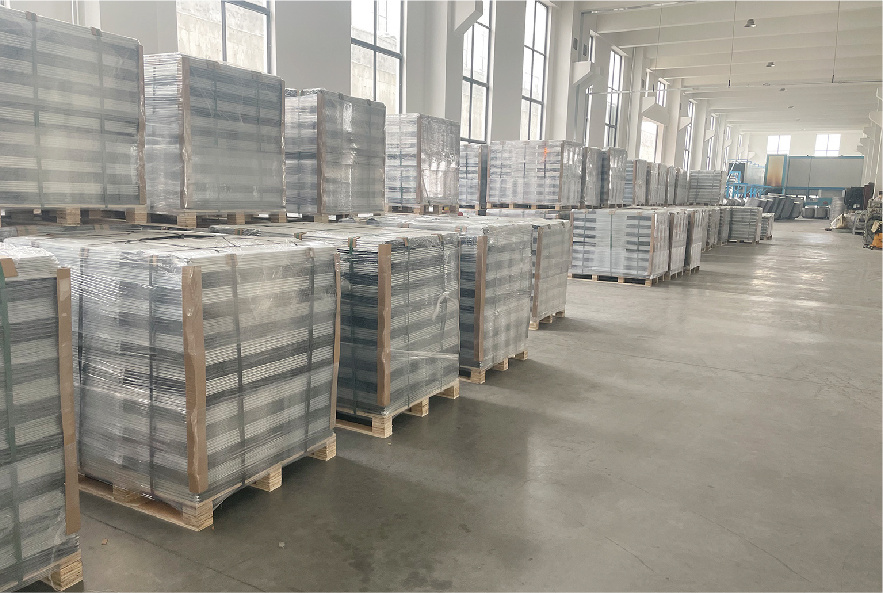
A supplier who can supply all of these on request is running a production process. One who cannot is often reselling someone else’s output, which means your specification passes through a middle layer before it reaches the machine.
6. Sample before you commit to a container
A sample tells you more about pack quality, finish and assembly than any brochure. Ask for one bay of the exact specification you intend to order, not a showcase unit built for the sample room.
Before paying a sample fee, agree two things: how long it takes to arrive, and how the cost is treated if you place a production order. A refundable deposit credited against your first order is the standard structure we work to.
7. Lock inspection rights into the order
The cheapest quality control happens before the container sails. Two rights are worth writing into the order:
- Pre-shipment evidence as standard — inspection records and container loading photographs sent to you before departure, not after arrival.
- The right to appoint a third-party inspector — you should be free to send in SGS, Bureau Veritas, Intertek or your own agent at any point during production or at loading. Expect the inspection fee to be yours; the right to inspect should not be.
If a supplier resists a third-party inspection, that is the most informative answer you will get all negotiation.
8. Agree the claims route before you need it
Shortages, transit damage and finish faults happen in international trade. What separates suppliers is what happens in the week after you tell them.
Before you order, ask these three questions and write the answers into the order confirmation:
- What response time do you commit to once we send photographs or an inspection report?
- Will the first response be a proposal, or a request for more information?
- Who pays freight on replacement parts, and on what basis?
A workable commitment is a written proposal within 48 hours of the photos or inspection report reaching the supplier. Anything vaguer turns into months of email.
9. Insist on warranty boundaries, not warranty adjectives
“Two-year warranty” means nothing without three details: when it starts, what it covers and what voids it.
- Start point — from the bill of lading date, so the clock is not consumed by transit and your own storage time.
- Coverage — manufacturing defects: material, workmanship and coating adhesion as supplied.
- Exclusions — overload beyond the rated capacity, misuse, impact damage on site, corrosion from an environment the product was not specified for, and damage during your own installation.
Tiered terms are common and reasonable: one year on light duty ranges, two on medium, three on heavy duty — measured from the bill of lading date. What matters is that the tier is written down against the product you are buying.
10. The mistakes that cost the most
| Mistake | What it costs |
|---|---|
| Comparing unit price without landed cost | A “cheaper” supplier that is more expensive delivered |
| Specifying load per shelf but not per bay | Uprights that are undersized for a fully loaded run |
| Accepting “heavy duty” with no thickness figure | Thinner steel than you budgeted for, discovered after arrival |
| No pre-shipment evidence | Problems found at destination, when remedies are slow and expensive |
| No agreed claims response time | Weeks of email, and a credit note that never arrives |
| Ignoring duty treatment by market | A margin that disappears at customs |
| Ordering a single size to fill the container | Poor mix, poor loading, stock you cannot sell through |
11. What a good supplier relationship looks like
You should not need to become a racking engineer to buy racking. The practical test is simple: you describe the load, the space and the market, and one person comes back with a specification, a landed-cost picture, a lead time and the two or three questions that actually need settling.
Everything after that — production, documentation, loading, and the occasional problem — should come back through that same person. When quoting, engineering, production and shipping all sit under one roof, your specification does not get reinterpreted on the way to the machine, and nobody gets to point at somebody else when something is wrong.
Frequently asked questions
What is the minimum order for steel shelving from China?
Practically, it is a container, because ocean freight is priced per box rather than per unit and part-container shipping destroys the unit economics. For standard heavy duty ranges, minimum order quantities typically start at 1,000 pcs across mixed sizes. Trial orders and OEM/ODM programmes are negotiable — ask for a specific figure against your specification.
Can I put my own brand on the product and packaging?
Yes. OEM and ODM are standard for this category. Custom carton printing, brand labels and instruction sheets are usually the easiest changes; custom colours, widths and depths require production tooling and therefore volume. Be explicit about which you want at the quotation stage, because it changes the price and the lead time.
How do I verify the load rating before I buy?
Ask for the upright steel thickness, the load per shelf and per bay, and a load test report on request. Then compare those numbers across suppliers rather than comparing adjectives. There is a full walkthrough in Shelf Load Ratings Explained.
Should I ship assembled or knocked down?
Knocked down, almost always. Flat-packed uprights and panels let you load several times more units per container, and assembly is tool-free on boltless systems. Shipping assembled steel shelving is one of the fastest ways to double your landed cost per shelf position.
Send us your specification
Tell us the sizes, the load per shelf, the container you are working with and the market you sell into. You will get pricing, lead time, the documentation we supply as standard, and one or two questions worth settling before you commit.
Keep reading: How to Choose Warehouse Shelving · Boltless vs Bolt-Together Shelving · Shelf Load Ratings Explained